Page 4 of 5

Lord, I Run to You

God is crazy about you! He who did not spare his own Son but gave him up for us all, how will he not also with him graciously give us all things? (Romans 8:32 ESV) He did the unthinkable…giving up his “only begotten son.” When we turn to other gods, He is obviously jealous.

Shall we provoke the Lord to jealousy? Are we stronger than he? (1 Corinthians 10:22 ESV)

God’s love for us allows him to be provoked to jealousy. He doesn’t want anyone or anything to come close to taking his place in our lives. We have never been loved, nor will we ever be loved, as deeply as God loves us. Idols can be obvious…or they can be subtle. Kyle Idleman, in his book Gods at War, writes:

“Where Is Your Sanctuary? Where do you go when you’re hurting? Let’s say it’s been a terrible day at the office. You come home and go — where? To the refrigerator for comfort food like ice cream? To the phone to vent with your most trusted friend? Do you seek escape in novels or movies or video games or pornography? Where do you look for emotional rescue? The Bible tells us that God is our refuge and strength, our help in times of trouble — so much so that we will not fear though the mountains fall into the heart of the sea (Ps. 46:1 – 2). That strikes me as a good place to run. But it’s so easy to forget, so easy for us to run in other directions. Where we go says a lot about who we are. The “high ground” we seek reveals the geography of our values.”

If you have the time (about 7 minutes) worship the Lord as Tommy Walker beautifully sings, “Lord, I Run to You.”

Do You Love Me?

“Simon, Simon, behold, Satan demanded to have you, that he might sift you like wheat, but I have prayed for you that your faith may not fail. And when you have turned again, strengthen your brothers.” (Luke 22:31-32 ESV)

IMG_1462
A boat on the Sea of Galilee

Peter faltered but he did not ultimately fail. Why? Because Jesus prayed for him. Not long after the above conversation Jesus was taken to the high priest’s house. A servant girl there recognized Peter as having been with Jesus. He lied and said he hadn’t. Two more bystanders approached Peter about his relationship with Jesus. Here’s what happened:

But Peter said, “Man, I do not know what you are talking about.” And immediately, while he was still speaking, the rooster crowed. And the Lord turned and looked at Peter. And Peter remembered the saying of the Lord, how he had said to him, “Before the rooster crows today, you will deny me three times.” And he went out and wept bitterly. (Luke 22:60-62 ESV)

Peter wept bitterly.

I wonder if, while weeping, he remembered the first time he met Jesus? “Come, follow me, and I will make you fishers of men.” Did he recount the time Jesus taught in the synagogue, walked down the road to Peter’s house and healed his mother-in-law? Or when he walked on the water–and was rescued by Jesus when he looked down at the water. Surely his mind was flooded with memories of time spent with Jesus he loved so much.

Peter wept bitterly. But Jesus had prayed for him.

Jesus was crucified and resurrected and went looking for Peter. He found him fishing again. Peter had abandoned his pulpit for a fishing net. A conversation ensued. Jesus asked Peter two times if he loved him. Peter answered “Yes!” Then he asked one more time.

He said to him the third time, “Simon, son of John, do you love me?” Peter was grieved because he said to him the third time, “Do you love me?” and he said to him, “Lord, you know everything; you know that I love you.” Jesus said to him, “Feed my sheep. (John 21:17 ESV)

Peter was grieved again. Three times he had denied Jesus. Now three times he has affirmed his love for him. He was so disappointed in himself. Would Jesus ever use him again? Did he have a future with this Jesus? Jesus’s response reassured Peter.

Truly, truly, I say to you, when you were young, you used to dress yourself and walk wherever you wanted, but when you are old, you will stretch out your hands, and another will dress you and carry you where you do not want to go.” (This he said to show by what kind of death he was to glorify God.) And after saying this he said to him, “Follow me.” (John 21:18-19 ESV)

Peter did more than follow! He preached the first sermon after Pentecost. He became the pastor of the Jerusalem church. He wrote two remarkable letters that made it into the New Testament. Why? Because Jesus prayed and Peter repented.

Jesus is praying for you. How will you answer his prayer?

“I Have Prayed for You”

“Simon, Simon, behold, Satan demanded to have you, that he might sift you like wheat, but I have prayed for you that your faith may not fail. And when you have turned again, strengthen your brothers.” Peter said to him, “Lord, I am ready to go with you both to prison and to death.” Jesus said, “I tell you, Peter, the rooster will not crow this day, until you deny three times that you know me.” (Luke 22:31-34 ESV)

Jesus sounds like the consummate parent–he calls Simon’s name twice–and Simon was Peter’s formal name. You can tell he wants Peter to hear what he has to say. Notice his language. If anyone knows Satan, it’s Jesus. He was in heaven when Satan was thrown out. Satan demanded. You have to wonder why Satan wanted Peter so badly that he would demand. Never forget that Satan can only do what God allows him to do. The tense of the verb “demanded” suggests that this happened at a particular time. When did Satan show up to Jesus and ask to destroy Peter?

wheatSatan wanted to sift Peter like wheat. I looked up sifting wheat in ancient times. Here’s what ehow.com had to say:

The first step in the process of sifting wheat is to loosen the chaff from the edible grain, which is called threshing. The old-fashioned way to do this is to spread the wheat onto a floor made from stone, concrete or tamped earth and to beat it with a flail. The next step is called winnowing, where the loosened chaff is removed from the grain. The old-fashioned way of doing this is to throw the grain in the air, where the lighter chaff is blown off by even a decent breeze. The heavier grain falls back to the ground below.

In other words Satan wanted to stomp Peter into the ground and throw him in the air while the wind blew through. Satan wanted to destroy Peter. What was Jesus’s response? I have prayed for you. Jesus prayed for Peter. That your faith may not fail. Peter, I have prayed that you will still believe I am who I am after you see me mercilessly beaten by the Romans. I have prayed for you that your faith may not fail after you see the cross on my shoulders. I have prayed that you will still believe when I am laid in the tomb.

Jesus prayed for Peter.

Peter didn’t get it. He was guilty of Paul’s warning in 1 Corinthians 10:12: Therefore let anyone who thinks that he stands take heed lest he fall. Peter thought he could handle Satan’s attacks. Jesus knew he couldn’t. Jesus prayed for Peter. And Jesus is praying for you too. 

Who is to condemn? Christ Jesus is the one who died—more than that, who was raised—who is at the right hand of God, who indeed is interceding for us. (Romans 8:34 ESV)

If you have trusted Christ as your Savior, He is praying for you now. Tomorrow we will eavesdrop on a conversation between Jesus and Peter on the seashore and learn how God answered Jesus’s prayer for Peter. Until then, rest in the reality that Jesus is praying for you.

Read more : http://www.ehow.com/how-does_4925686_farmers-sift-wheat.html

The Room

Joshua Harris, pastor in New England, had this dream years ago as a teenager. It was originally published in New Attitude magazine in 1995. If you struggle with guilt over past, forgiven sins, this is a must read. If you think your sins are too much for God, read this.

In that place between wakefulness and dreams, I found myself in the room. There were no distinguishing features save for the one wall covered with small index-card files. They were like the ones in libraries that list titles by author or subject in alphabetical order. But these files, which stretched from floor to ceiling and seemingly endlessly in either direction, had very different headings. As I drew near the wall of files, the first to catch my attention was one that read “Girls I Have Liked.” I opened it and began flipping through the cards. I quickly shut it, shocked to realize that I recognized the names written on each one.

And then without being told, I knew exactly where I was. This lifeless room with its small files was a crude catalog system for my life. Here were written the actions of my every moment, big and small, in a detail my memory couldn’t match.

A sense of wonder and curiosity, coupled with horror, stirred within me as I began randomly opening files and exploring their content. Some brought joy and sweet memories; others a sense of shame and regret so intense that I would look over my shoulder to see if anyone was watching. A file named “Friends” was next to one marked “Friends I Have Betrayed.”

The titles ranged from the mundane to the outright weird. “Books I Have Read,” “Lies I Have Told,” “Comfort I Have Given,” “Jokes I Have Laughed At.” Some were almost hilarious in their exactness: “Things I’ve Yelled at My Brothers.” Others I couldn’t laugh at: “Things I Have Done in My Anger,” “Things I Have Muttered Under My Breath at My Parents.” I never ceased to be surprised by the contents. Often there were many more cards than I expected. Sometimes fewer than I hoped.

I was overwhelmed by the sheer volume of the life I had lived. Could it be possible that I had the time in my 20 years to write each of these thousands or even millions of cards? But each card confirmed this truth. Each was written in my own handwriting. Each signed with my signature.

When I pulled out the file marked “Songs I Have Listened To,” I realized the files grew to contain their contents. The cards were packed tightly, and yet after two or three yards, I hadn’t found the end of the file. I shut it, shamed, not so much by the quality of music, but more by the vast amount of time I knew that file represented.

When I came to a file marked “Lustful Thoughts,” I felt a chill run through my body. I pulled the file out only an inch, not willing to test its size, and drew out a card. I shuddered at its detailed content. I felt sick to think that such a moment had been recorded.

An almost animal rage broke on me. One thought dominated my mind: “No one must ever see these cards! No one must ever see this room! I have to destroy them!” In an insane frenzy I yanked the file out. Its size didn’t matter now. I had to empty it and burn the cards. But as I took it at one end and began pounding it on the floor, I could not dislodge a single card. I became desperate and pulled out a card, only to find it as strong as steel when I tried to tear it

Defeated and utterly helpless, I returned the file to its slot. Leaning my forehead against the wall, I let out a long, self-pitying sigh. And then I saw it. The title bore “People I Have Shared the Gospel With.” The handle was brighter than those around it, newer, almost unused. I pulled on its handle and a small box not more than three inches long fell into my hands. I could count the cards it contained on one hand.

And then the tears came. I began to weep. Sobs so deep that they hurt started in my stomach and shook through me. I fell on my knees and cried. I cried out of shame, from the overwhelming shame of it all. The rows of file shelves swirled in my tear-filled eyes. No one must ever, ever know of this room. I must lock it up and hide the key.

But then as I pushed away the tears, I saw Him. No, please not Him. Not here. Oh, anyone but Jesus.

I watched helplessly as He began to open the files and read the cards. I couldn’t bear to watch His response. And in the moments I could bring myself to look at His face, I saw a sorrow deeper than my own. He seemed to intuitively go to the worst boxes. Why did He have to read every one?

Finally He turned and looked at me from across the room. He looked at me with pity in His eyes. But this was a pity that didn’t anger me. I dropped my head, covered my face with my hands and began to cry again. He walked over and put His arm around me. He could have said so many things. But He didn’t say a word. He just cried with me.

Then He got up and walked back to the wall of files. Starting at one end of the room, He took out a file and, one by one, began to sign His name over mine on each card.

“No!” I shouted rushing to Him. All I could find to say was “No, no,” as I pulled the card from Him. His name shouldn’t be on these cards. But there it was, written in red so rich, so dark, so alive. The name of Jesus covered mine. It was written with His blood.

He gently took the card back. He smiled a sad smile and began to sign the cards. I don’t think I’ll ever understand how He did it so quickly, but the next instant it seemed I heard Him close the last file and walk back to my side. He placed His hand on my shoulder and said, “It is finished.”

I stood up, and He led me out of the room. There was no lock on its door. There were still cards to be written.

By Joshua Harris. Orginally published in New Attitude Magazine. Copyright New Attitude, 1995. You have permission to reprint this in any form. We only ask that you include the appropriate copyright byline and do not alter the content.

Sinning Against Christ

earthIn 1 Corinthians 8 Paul addressed a very specific problem in the Corinthian church: eating meat offered to idols. Some possessed a special knowledge:

Therefore, as to the eating of food offered to idols, we know that “an idol has no real existence,” and that “there is no God but one.” (1 Corinthians 8:4 ESV)

There was nothing wrong with this knowledge: as a matter of fact, there was everything right with it! Idols have no real existence. Their power is not inherent–it lies in the illusions of peoples’ minds who worship them. There is no God but one.  God, the Creator, Sustainer and Redeemer of the universe stands alone as God. He is unequaled in power and position. In 1867, Walter Smith wrote these words:

Immortal, invisible, God only wise, in light inaccessible hid from our eyes, most blessed, most glorious, the Ancient of Days, almighty, victorious, thy great name we praise.

Unresting, unhasting, and silent as light, nor wanting, nor wasting, thou rulest in might: thy justice, like mountains high soaring above, thy clouds which are fountains of goodness and love.

Some, knowing how great God was and how foolish idols were, had no problem eating meat offered to idols. “There’s nothing wrong with that meat,” they thought! “God is greater than those idols.” What they didn’t realize was that, sitting in their midst, were weak-minded new Christians. Their faith wasn’t sure–their understanding shallow. They were spooked by the meat and for them to eat it meant they had returned to their old way of life. Paul made it clear: when you notice such a brother, put the meat aside. Don’t offend him. How far did he go in giving this instruction:

Thus, sinning against your brothers and wounding their conscience when it is weak, you sin against Christ. (1 Corinthians 8:12 ESV)

From Paul’s statement we learn that Christ lives in his people–weak and strong. The strong are to bear the burdens of the weak. Rather than wounding their conscience, build their faith. This takes the focus off of meat and puts it on the Message.

Smith finishes his great hymn:

To all, life thou givest, to both great and small; in all life thou livest, the true life of all; we blossom and flourish like leaves on the tree, then wither and perish, but naught changeth thee.

Thou reignest in glory, thou dwellest in light, thine angels adore thee, all veiling their sight; all praise we would render; O help us to see, ’tis only the splendor of light hideth thee!

Please Don’t Trip Me Up

However, not all possess this knowledge. But some, through former association with idols, eat food as really offered to an idol, and their conscience, being weak, is defiled.  Food will not commend us to God. We are no worse off if we do not eat, and no better off if we do. But take care that this right of yours does not somehow become a stumbling block to the weak. (1 Corinthians 8:7-9 ESV)

oo_stumblesIf newborn Christians could articulate it, I think this is what they would say:

I’m a newbie, green behind the ears, just a few days old. I still have flashbacks from my old way of life. Sometimes I’m up–other times I’m down. When I come to a worship service, I feel so close to God. By Tuesday I feel vulnerable, even afraid.

Please don’t trip me up.

My old friends are gone. I can’t hang out with them anymore–and they think I’m weird anyway. They don’t understand why what I once did is so wrong to me, and what I want to do seems so weird to them. I use phrases like “brother” for someone not even related to me. And sometimes I talk about loving someone I’ve barely known.

Please don’t trip me up.

I have questions and I feel dumb asking them. When the preacher says to turn somewhere in the Bible, I’m thankful for my smart phone. I have no idea where a book is, let alone chapter and verse. Everybody around me seems so smart–I have so much to learn.

Please don’t trip me up.

I don’t understand the Trinity–and I actually think other people do! I thought it would be interesting to read the book of Revelation…and then someone told me that wasn’t the best idea. So I started in Genesis. I actually made it to Leviticus. What was I thinking?

Please don’t trip me up.

I have this nagging fear. What if I mess up? Blow it? Fall into the same sin that plagued me before I trusted Christ. What if I fail.

Please don’t trip me up.

God Knows Me!

But if anyone loves God, he is known by God. (1 Corinthians 8:3 ESV)known

To know God is the privilege of a lifetime. To be known by God is the reward of eternity. J. I. Packer says it like this:

What matters supremely is not, in the last analysis, the fact that I know God, but the larger fact which underlies it — the fact that he knows me. I am graven on the palms of his hands. I am never out of his mind. All my knowledge of him depends on his sustained initiative in knowing me. I know him because he first knew me, and continues to know me. He knows me as a friend, one who loves me; and there is not a moment when his eye is off me, or his attention distracted from me, and no moment, therefore, when his care falters.

This is momentous knowledge. There is unspeakable comfort — the sort of comfort that energizes, be it said, not enervates — in knowing that God is constantly taking knowledge of me in love and watching over me for my good. There is tremendous relief in knowing that his love to me is utterly realistic, based at every point on prior knowledge of the worst about me, so that no discovery now can disillusion him about me, in the way I am so often disillusioned about myself, and quench his determination to bless me. (From Knowing God)

God All Sufficient

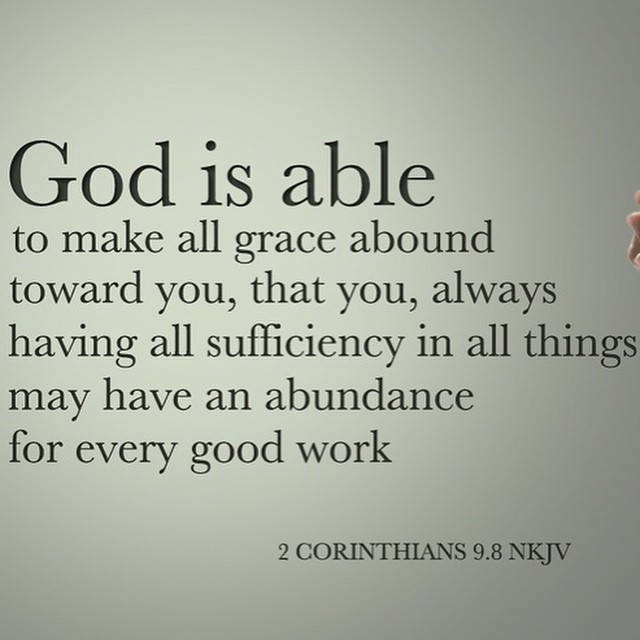
From The Valley of Vision (a book of Puritan prayers):godisable

O Lord of grace,

The world is before me this day, and I am weak and fearful, but I look to you for strength;

If I venture forth alone I stumble and fall, but on the Beloved’s arms I am firm as the eternal hills;

If left to the treachery of my heart I shall shame your name, but if enlightened, guided, upheld by your Spirit, I shall bring you glory.

Be thou my arm to support, my strength to stand, my light to see, my feet to run, my shield to protect, my sword to repel, my sun to warm.

To enrich me will not diminish your fullness; all your lovingkindness is in your Son. I bring him to you in the arms of faith. I urge his saving Name as the One who died for me. I plead his blood to pay my debts of wrong.

Accept his worthiness for my unworthiness, his sinlessness for my transgressions, his purity for my uncleanness, his sincerity for my guile, his truth for my deceits, his meekness for my pride, his constancy for my backslidings, his love for my enmity, his fullness for my emptiness, his faithfulness for my treachery, his obedience for my lawlessness, his glory for my shame, his devotedness for my waywardness, his holy life for my unchaste ways, his righteousness for my dead works, his death for my life.

What a Day That Will Be!

And after you have suffered a little while, the God of all grace, who has called you to his eternal glory in Christ, will himself restore, confirm, strengthen, and establish you. (1 Peter 5:10 ESV)whataday

Sometimes knowing how familiar words are defined can be worshipful in the study of Scripture. Here’s how dictionary.com defines these four words:

Restoreto bring back to a former, original, or normal condition, as a building, statue, or painting; to bring back to a state of health, soundness, or vigor. And here’s the kicker: we don’t know what our former, original condition looked like. We have never experienced it! We have to go all the way back to the Garden of Eden, see Adam and Eve without the condition of sin to know that. What a Day That Will Be!

Confirm–to establish the truth, accuracy, validity, or genuineness of; corroborate; verify: to acknowledge with definite assurance. Peter wrote to scattered Christians who had lost their homeland and their identity as good Jews. Here he promises them a permanent place with a permanent status. What a Day that Will Be!

Strengthento make stronger; give strength. What encouragement! To those who are physically or emotionally weak right now–God will strengthen you! It may be today…it will definitely happen in eternity. What a Day that Will Be!

Peter saved the best for last:

Establishto found, institute, build, or bring into being on a firm or stable basis; install or settle in a position, place; to show to be valid or true; prove; to establish the facts of the matter; to cause to be accepted or recognized; to bring about permanently. What a Day that Will Be!

John Newton, former slave trader and author of Amazing Grace, said it this way:

“I am not what I ought to be, I am not what I want to be, I am not what I hope to be in another world; but still I am not what I once used to be, and by the grace of God I am what I am.”

If you have time, take about 2 minutes and listen to the words of this old song:

Debt Free Living

For our sake he made him to be sin who knew no sin, so that in him we might become the righteousness of God. (2 Corinthians 5:21 ESV)

opraiseOnce Wendy and I were having dinner in a nice restaurant, enjoying the meal, enjoying one another’s company. We got ready to leave and there was no bill to pay. The waitress told us someone had paid it. “Wait a minute,” I contested, “who did that?” I wanted to thank them. Part of me wanted to try to pay them back. There was nothing I could do. The bill was paid…in full.

When I was 15 years old I attended a revival service. That night, for the first time, I realized I had a massive sin debt that only Jesus could handle. I had broken God’s law, broken Jesus’s heart, and acted a fool in my pride. As soon as the pastor finished preaching I went forward and received Jesus’s payment in full for my sins. What a sinner I was…what a Savior he is!

In 1865 Elvina Hall penned the words that say, better than I ever could, how I feel about what Jesus has done for me. Sing them as you read them:

I hear the Savior say,
Thy strength indeed is small;
Child of weakness, watch and pray,
Find in Me thine all in all.

Jesus paid it all,
All to Him I owe;
Sin had left a crimson stain,
He washed it white as snow.

Lord, now indeed I find
Thy power and Thine alone,
Can change the leper’s spots
and melt the heart of stone.

Jesus paid it all,
All to Him I owe;
Sin had left a crimson stain,
He washed it white as snow.

And when before the throne
I stand in Him complete,
Jesus died my soul to save,
my lips shall still repeat

Jesus paid it all,
All to Him I owe;
Sin had left a crimson stain,
He washed it white as snow

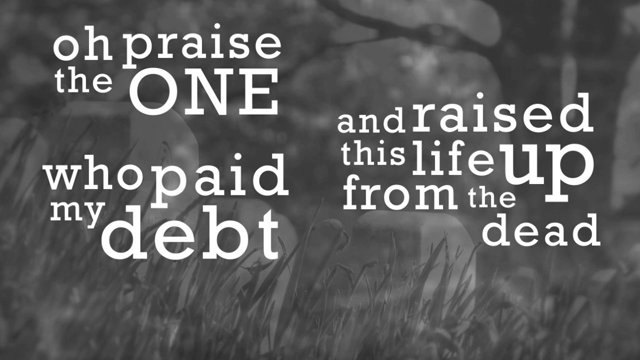
O praise the one who paid my debt and raised this life up from the dead!